Manufacturing a 3D or sculptural solid surface reception desk requires more than bending a sheet into a curved shape. The process combines design engineering, material selection, thermoforming, CNC machining, structural support, precision joining, and surface finishing. Each stage must work together to achieve the intended geometry while maintaining dimensional accuracy, a consistent appearance, and practical functionality.
For commercial interiors, the manufacturing challenge is particularly important because a reception desk must function as a workstation as well as an architectural feature. Complex curves, raised transaction counters, integrated lighting, and concealed cable management all need to be considered before fabrication begins.
This guide explains how sculptural solid surface reception desks are manufactured, which technical factors affect the final result, and what architects, contractors, and project buyers should confirm before approving a custom design.
What Makes a Solid Surface Reception Desk Three-Dimensional?
A conventional reception counter is usually built from flat panels arranged in a straight or angular configuration. A 3D solid surface reception desk introduces additional geometry, such as curved fronts, rounded corners, wave-shaped profiles, sculpted edges, or surfaces that change direction across multiple planes.
These designs may combine flat sheets, thermoformed components, CNC-machined sections, and an internal supporting structure. The visible surface is only one part of the product; the desk must also accommodate staff workspaces, transaction counters, storage, electrical connections, and installation requirements.
The manufacturing approach depends on the shape. A simple curved front may be produced through thermoforming, while a deeply sculpted or ribbed design may require CNC machining and the assembly of multiple components. The appropriate process should be determined from the approved design rather than assuming every 3D desk is made in the same way.
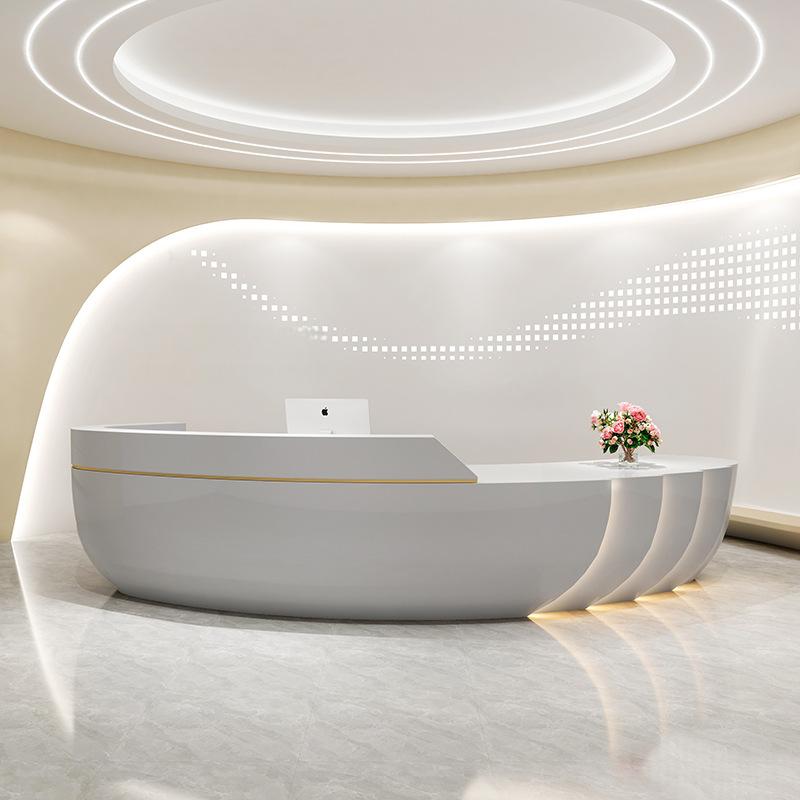
A sculptural reception desk combines curved surface geometry with functional counter space.
Material Selection Determines the Available Manufacturing Methods
The first manufacturing decision is choosing a material that can achieve the required shape. Thermoformable acrylic solid surface is commonly used for curved reception desks because suitable sheets can be softened through controlled heating and formed into customized geometries.
Not all solid surface or engineered stone materials behave in the same way. Acrylic solid surface can be suitable for thermoforming, while conventional engineered quartz and natural stone are generally fabricated through cutting, edge processing, and joining rather than the same heat-forming process.
Material selection should therefore consider more than color and appearance. The fabricator needs to evaluate the material formulation, sheet thickness, intended curvature, surface finish, and expected use of the finished reception desk.
KY Quartz offers custom curved solid surface reception desks for commercial interiors, with acrylic solid surface material and customized dimensions, shapes, and color options based on project requirements.
Design Engineering and CAD Preparation
The manufacturing process begins with a complete design package. CAD drawings or 3D models help translate the visual concept into measurable dimensions and identify the areas that require specialized fabrication.
For a sculptural reception desk, the design team should define the overall length, depth, height, front profile, countertop geometry, and internal layout. Curved sections also require clear information about their shape and transition into adjoining surfaces.
The drawings should also identify practical details that can be overlooked during concept design:
- Staff-side workspace and transaction counter dimensions.
- Monitor positions, cable openings, and internal cable routes.
- Storage compartments and access panels, where required.
- Internal support locations and connections between components.
- Installation access, transport limitations, and modular connections.
A design that looks correct in a rendering may still be difficult to manufacture or install. Reviewing the geometry, internal structure, and service requirements before production helps identify these problems early.
Thermoforming Creates the Main Curved Geometry
Thermoforming is used to shape suitable solid surface sheets into curved or three-dimensional components. The material is heated under controlled conditions until it becomes flexible enough to form, then positioned against a prepared mold and shaped to the required geometry.
The heating conditions depend on the specific material formulation, sheet thickness, equipment, and forming radius. A manufacturer should establish the appropriate process from the material specification and production trials rather than applying one temperature or heating time to every design.
The mold defines the intended shape. For reception desks, this may include a curved front fascia, a rounded counter edge, or a component with a more complex profile. The forming process must achieve the required geometry without unacceptable surface defects or dimensional changes.
After forming, the component needs suitable support while it cools and stabilizes. This is especially important for large or complex sections that must fit accurately with other parts during assembly.
For projects involving custom curved furniture, the solid surface thermoforming process provides the technical foundation for producing the main curved components.
CNC Machining Produces Precise Sculptural Details
Thermoforming creates the basic curve, but CNC machining is often needed to produce the final dimensions and more detailed surface geometry. Computer-controlled cutting and routing can shape edges, openings, joints, and decorative profiles according to the approved drawings.
For a sculptural reception desk, CNC machining may be used to create a wave-shaped front, repeated ribs, curved cutouts, or carefully aligned connection points. It can also prepare the edges of components that will later be bonded together.
The toolpath, material thickness, and geometry need to be coordinated. Excessive material removal or unsuitable machining conditions can affect the surface finish and the remaining section thickness.
A ribbed design illustrates how CNC machining can create a sculptural appearance without relying entirely on thermoforming. Individual ribs can be machined and assembled over a supporting structure to create a continuous visual volume.
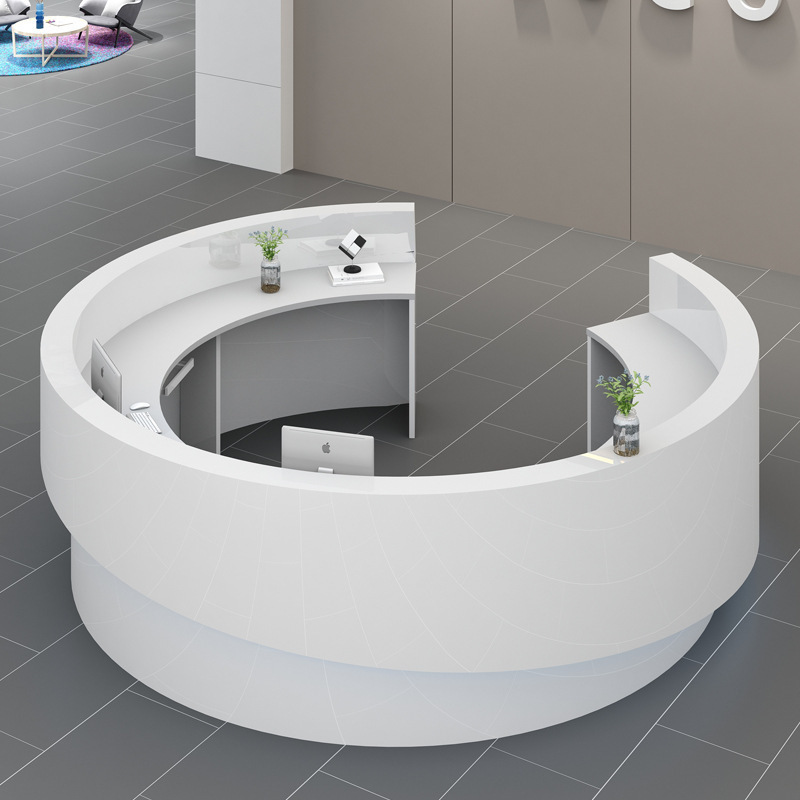
Complex curved profiles require accurate machining and coordination between adjoining components.
For a different approach to sculptural detailing, KY Quartz also offers a custom organic ribbed wave curved reception desk, featuring a wave-shaped front assembled from CNC-machined solid surface ribs over a supporting core.
Structural Support and Internal Engineering
The solid surface exterior is not normally the only structural element of a large reception desk. An internal frame or core may be required to support the countertop, maintain the intended geometry, and provide fixing points for the assembled components.
The support structure should be considered during design engineering. Its layout must accommodate the desk's dimensions, countertop loads, staff-side equipment, storage, and the locations of cable routes or other integrated features.
The choice of support material and construction method depends on the project. A steel subframe, plywood core, or another suitable structure may be specified according to the design and load requirements. These details should be confirmed by the project team rather than assumed from the exterior appearance.
For larger reception counters, modular construction may also be necessary to make transport and installation manageable. In this case, the position of each connection should be coordinated with the surface panels and internal frame so that the components can be assembled accurately on site.
Seamless Joining and Surface Finishing
A sculptural reception desk may contain several formed and machined components. The way these components are joined has a direct effect on the final appearance.
Color-matched adhesive can be used to bond compatible solid surface components. The joint surfaces must be properly prepared, aligned, and clamped according to the adhesive and material requirements. After bonding, the joint can be sanded and polished to reduce its visual impact.
The objective is a consistent surface appearance across the curved and flat sections. However, a visually seamless finish does not mean that every reception desk is made from a single piece of material. The actual construction may involve several components joined through controlled fabrication.
Surface finishing may include edge shaping, sanding, polishing, and final cleaning. The required finish should be confirmed against the approved sample or design specification before the product is accepted.
Quality Control Before Delivery
Quality control should cover both the visible surface and the functional construction of the reception desk. A product may have an attractive exterior but still require correction if its dimensions, connections, or internal layout do not match the approved drawings.
The following checks are useful for custom 3D reception desk projects:
| Quality Check | What to Verify |
|---|---|
| Dimensional accuracy | Overall dimensions, counter heights, curve profiles, and component alignment against approved drawings. |
| Surface appearance | Consistent color and finish, with no unacceptable forming marks, scratches, or surface irregularities. |
| Joint quality | Alignment, adhesive finish, and visual consistency at connections between components. |
| Structural stability | Support frame, connections, countertop support, and stability under the intended use conditions. |
| Functional details | Cable openings, storage access, lighting provisions, and compatibility with required equipment. |
For large or modular desks, a factory trial assembly can help identify alignment or connection issues before packing. Where a full assembly is not practical, component dimensions and connection details should be checked against the approved installation drawings.
How to Choose a Manufacturer for Sculptural Reception Desks
A suitable manufacturer should be able to evaluate the design and explain how the required shape will be produced. The ability to create a visually appealing concept is only one part of the process; the supplier also needs to address material suitability, tooling, structural support, and installation.
Before approving a project, buyers should confirm:
- Whether the selected material is suitable for the required forming method.
- How complex curves, joints, and sculptural details will be manufactured.
- Whether the supplier can work from CAD drawings or 3D models.
- How the internal support structure and functional requirements will be coordinated.
- What inspection, trial assembly, and installation information will be provided.
KY Quartz provides custom solid surface reception desks for commercial interiors, with product options that include curved, sculptural, and customized configurations. Project requirements can be discussed with the manufacturer using drawings, dimensions, and the intended application.
Frequently Asked Questions
How are 3D solid surface reception desks manufactured?
The process typically includes design engineering, material selection, thermoforming or CNC machining, structural support, component joining, surface finishing, and quality inspection. The exact sequence depends on the geometry and construction method.
Which material is suitable for sculptural solid surface reception desks?
Thermoformable acrylic solid surface is commonly used for curved and sculptural designs. The appropriate material depends on the required shape, sheet thickness, finish, and intended application. Conventional engineered quartz and natural stone generally require different fabrication methods.
Can a reception desk be manufactured directly from CAD or 3D drawings?
Yes. CAD drawings and 3D models can define the dimensions, geometry, and functional layout of a custom desk. The manufacturer should review the drawings for material suitability, fabrication feasibility, support requirements, and installation details before production.
How are seamless joints achieved on curved reception desks?
Compatible solid surface components can be bonded with color-matched adhesive. Accurate joint preparation, alignment, clamping, and surface finishing help create a visually continuous appearance. The actual construction may still involve multiple joined components.
Why is an internal support structure important?
The support structure helps maintain the desk's geometry and supports the countertop, equipment, and other functional components. It should be designed alongside the exterior shape so that the finished desk meets the project's structural and installation requirements.
What should buyers check before approving a custom reception desk?
Buyers should review the material specification, approved drawings, dimensions, finish, joint details, internal structure, functional openings, and installation requirements. A sample or trial assembly can help verify important details before delivery.
Conclusion
Manufacturing a 3D or sculptural solid surface reception desk is a coordinated process that combines material knowledge, design engineering, forming, machining, structural support, and precision finishing. Thermoforming can create the main curved geometry, while CNC machining and controlled joining help produce the final details.
The most reliable results come from resolving the technical requirements before fabrication begins. Accurate drawings, suitable materials, well-planned support structures, and consistent quality checks help turn complex design concepts into functional reception furniture for commercial interiors.
For a custom reception desk project, provide the manufacturer with the intended dimensions, drawings, finish requirements, and installation conditions. These details form the basis for evaluating the design and developing a practical fabrication plan.