Antimicrobial wall panels work by embedding silver ions into the panel material, where they continuously disrupt microbes on contact. This matters for homes, clinics, schools, and commercial spaces. You get cleaner, longer-lasting surfaces. Here is a plain-language walkthrough of the science, from the molecular level to real-world performance.
Key Takeaways
-
Silver ions inside the panels attack microbes on contact, disrupting their cells and stopping growth.
-
These panels fight bacteria, fungi, and viruses, providing broad protection for homes, clinics, and schools.
-
The antimicrobial effect lasts for 20+ years and does not wash off or wear away, even with frequent cleaning.
How Antimicrobial Wall Panels Use Silver Ions
Antimicrobial vs. Antibacterial
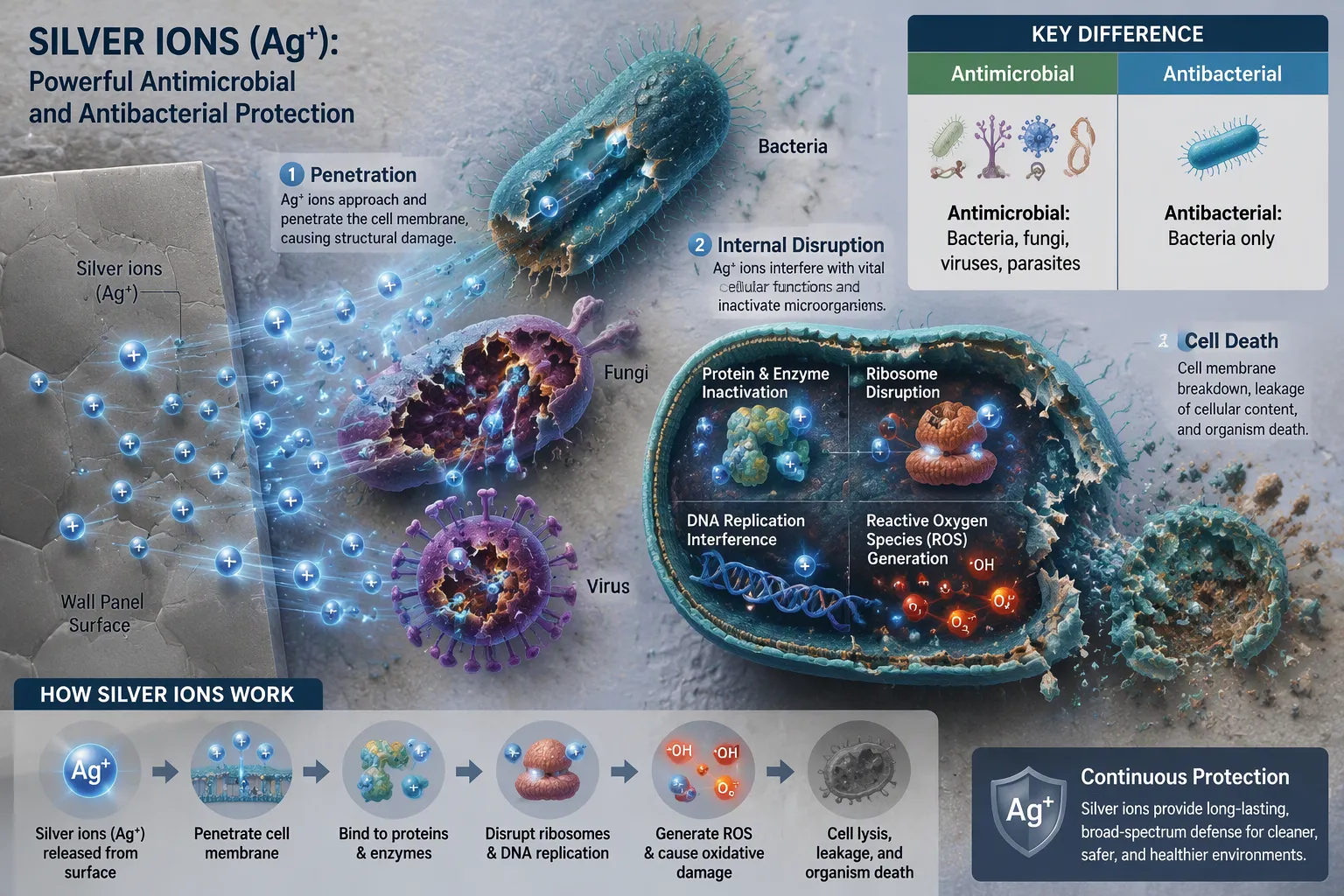
You often see these two terms used interchangeably. They are not the same. Antibacterial products target bacteria only. They kill bacteria or stop their growth. Antimicrobial products cast a much wider net. They fight bacteria, fungi, viruses, and protozoans. Think of antibacterial as a subset of antimicrobial. The table below makes the difference clear.
|
Agent Type |
Microorganisms Targeted |
Scope |
|---|---|---|
|
Antimicrobial |
Bacteria, fungi, viruses, and parasites |
Broad-spectrum; can halt growth or eliminate many microorganism types |
|
Antibacterial |
Bacteria only |
Narrow-spectrum; kills or inhibits growth of bacteria |
This distinction matters when you choose surfaces for a clinic, a school, or a food-prep area. A bacteria-only solution leaves other threats behind. Antimicrobial Wall Panels address the broader range.
Silver Ions vs. Microbes
The active agent in these panels is the positively charged silver ion, written as Ag+. This holds true no matter which silver form the manufacturer starts with. Once released, Ag+ ions go to work. This process is what we call silver ion wall protection.
The mechanism unfolds in several steps. First, Ag+ ions are highly reactive in water. They are drawn to microbial cell membranes. They penetrate those membranes with ease. Second, inside the cell, silver ions bind to vital proteins and enzymes. This binding inactivates the enzymes needed for respiration, metabolism, and production. Third, the cell membrane breaks down. The organism dies.
Silver ions also disrupt ribosomes, which stops protein synthesis. They interfere with DNA replication, so cells cannot multiply. They even generate reactive oxygen species that damage proteins, lipids, and DNA. This multi-pronged attack makes it hard for microbes to adapt. The mechanism works against over 650 types of disease-causing microorganisms.
Silver has a long history as a disinfectant. People used silver vessels to preserve water and wine in ancient Greece. In the 19th century, silver nitrate became a standard antiseptic for wound care. Doctors used it to prevent eye infections in newborns. Today, silver ions purify water and disinfect air. Silver-impregnated filters and silver-coated air filters both rely on this same chemistry.
Inside Antimicrobial Wall Panels: Integration and Performance
Built Into the Material
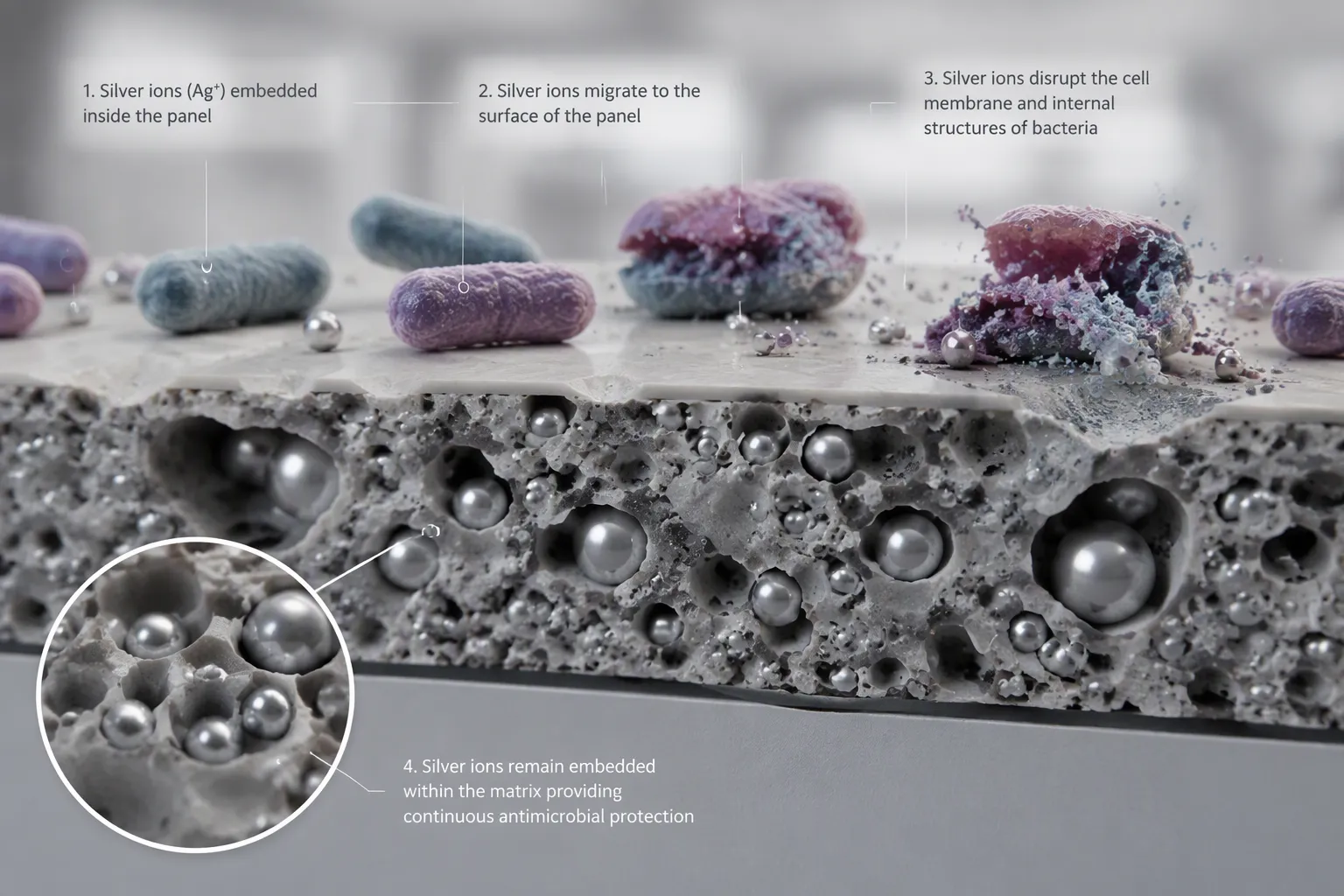
Manufacturers add silver-ion technology during production, not as a surface coating. The active ingredient becomes part of the panel itself. This approach delivers a key advantage. The protection cannot wash off, scratch away, or wear thin over time. Parklex Prodema confirms this point. The company states that antibacterial elements are an integral part of the product composition. The protection is inherent to the product rather than an added coating. This design supports long-lasting and effective performance.
The benefits extend further. The material reduces microbial and bacterial colony formation. It protects against mold, mildew, and fungi. The antimicrobial effect lasts for the life of the product. Activity remains even when the surface is worn or scuffed. The hygienic properties survive forming and fabrication too. The material is non-toxic and meets USDA and FDA compliance standards.
Speed, Duration, and Coverage
Silver ions act on contact. The moment a microbe lands on the surface, the ions begin their attack. Lab testing confirms the results. Under ISO 22196 and JIS Z 2801 standards, these surfaces reduce bacterial colonization by more than 99%. That means 99.9% of microbes cannot survive on the surface. You get wall panels that kill bacteria around the clock.
Duration matters just as much as speed. These panels deliver continuous protection for 20+ years with proper maintenance. They withstand frequent cleaning without losing potency. The seamless, non-porous surface design adds another layer of defense. Microbes have nowhere to hide, and cleaning becomes easier.
Biofilm formation is a serious concern in wet environments. Silver ions help here too. They disrupt bacterial cell membranes, inhibit DNA replication, and prevent biofilm formation. The technology targets MRSA, E. coli, Pseudomonas aeruginosa, and other pathogens relevant to operating rooms. This mirrors the approach used in silver-ion–lined antimicrobial tubing and fittings.
One study offers a cautionary note. Researchers used 100 μg/liter silver to prevent biofilm formation in modified Robbins devices with polyvinyl chloride and stainless steel surfaces. They found no significant difference between the silver treatment and the control on either surface. This finding shows that silver concentration and surface material both influence results. Quality manufacturing matters.
Guangzhou Pinger is one example of a manufacturer applying this technology. The company integrates silver ions into its Antimicrobial Wall Panels during production. Buyers seeking an antibacterial wall covering for hospitals can look to such suppliers for verified performance.
Silver ions sit inside the panel material. They disrupt microbes on contact. You get lasting protection without harsh chemicals. These Antimicrobial Wall Panels offer continuous action, broad coverage, low maintenance, and fit hygiene-sensitive spaces like an antibacterial wall covering for hospitals. Guangzhou Pinger applies this technology. Antimicrobial surfaces will become standard in modern building materials.
FAQ
How long does the antimicrobial protection last?
You get continuous protection for 20+ years with proper maintenance. The silver ions sit inside the material, so the effect does not wash off or wear away.
Do these panels fight viruses and fungi too?
Yes. The silver ions target bacteria, fungi, viruses, and protozoans. This broad coverage makes Antimicrobial Wall Panels suitable for clinics, schools, and food-prep areas.
Does regular cleaning reduce the antimicrobial effect?
No. You can clean these surfaces often without losing potency. The silver-ion technology stays active for the life of the product, even when the surface is scuffed.