ASTM E84 Class A, EN 13501, and GB 8624 are three distinct regional fire rating systems. They are not interchangeable. Each measures different fire performance aspects. Specifying the wrong rating can cause failed inspections, rejected shipments, or unsafe installations. This article helps readers compare these systems for Fire Ratings for Wall Protection, identify which standard applies to their project, and verify supplier claims.
Key Takeaways
-
Fire ratings differ by region: ASTM E84 for North America, EN 13501 for Europe, and GB 8624 for China. Each uses different tests and scales.
-
Never swap ratings between systems. A product passing one standard may fail another, leading to rejected shipments or failed inspections.
-
Always verify the exact rating your local building code requires. Request full test reports and check laboratory accreditation.
Why Fire Ratings for Wall Protection Differ
Regional Standards and Building Codes
Wall protection products must satisfy the fire code of the country where they are installed. The United States relies on ASTM E84, where Class A is the common target for wall cladding. Europe uses EN 13501-1, and Class B with the s1,d0 sub-classifications is a frequent requirement. China follows GB 8624, where B1 or A2 is typical for wall panels.
These three systems grew from separate regulatory traditions. Each one answers a different question about how a material behaves in a fire. A product that passes one test does not automatically pass another.
The Risk of Assuming Equivalence
Direct equivalence between standards is not always straightforward. Test methods differ, pass thresholds differ, and the intended material application differs. ASTM E84 Class A requires a flame spread index of 25 or less, measured in a 25-foot tunnel. EN 13501-1 Class B evaluates reaction to fire through a different set of tests. GB 8624 combines surface burning with additional performance data.
A rating earned under one standard says nothing about performance under another.
This gap creates real danger for specifiers. A supplier may present an ASTM E84 Class A report for a project that requires EN 13501-1 Class B. The document looks impressive, but it does not satisfy the local fire code for wall cladding. Inspectors reject the installation, shipments sit in customs, and the project stalls.
The safest approach treats each standard as its own language. Confirm the exact rating your building code demands, then verify the product holds that rating from an accredited laboratory.
Side-by-Side Comparison at a Glance
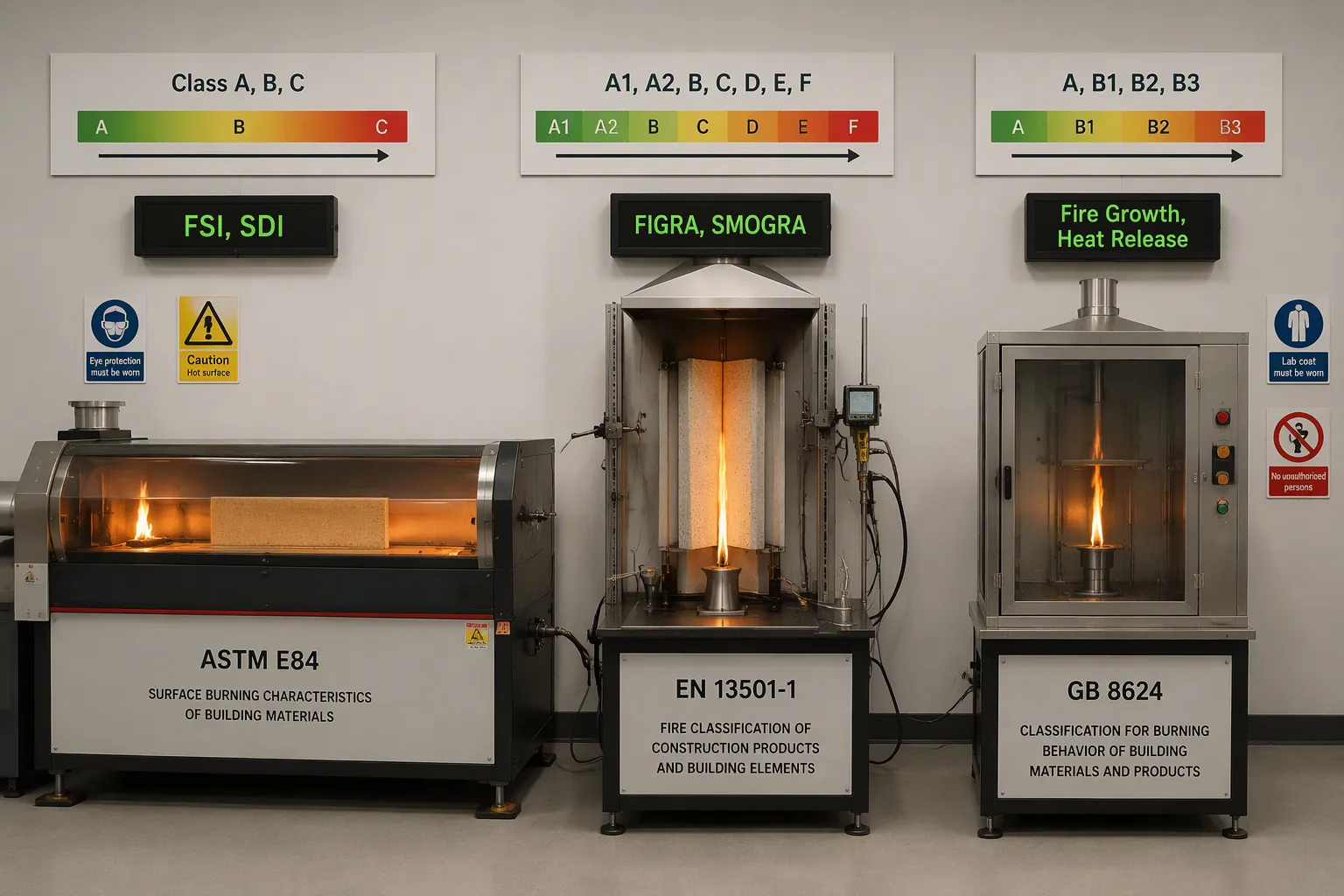
Region, Test Method, and Key Parameters
The three systems serve different markets and rely on different apparatus. The table below summarizes the core differences.
|
Aspect |
ASTM E84 |
EN 13501-1 |
GB 8624 |
|---|---|---|---|
|
Region |
North America (US, Canada) |
European Union and adopting countries |
China |
|
Main test method |
Steiner Tunnel test (25-ft tunnel) |
EN 13823 (SBI) plus EN ISO 11925-2 small flame |
GB/T 20284 (SBI-type) plus GB/T 8626 small flame |
|
Key parameters |
Flame Spread Index (FSI), Smoke Developed Index (SDI) |
FIGRA, THR600s, SMOGRA, TSP600s, flaming droplets |
Fire growth, heat release, smoke, flaming droplets |
|
Classification scale |
Class A, B, C |
A1, A2, B, C, D, E, F plus s/d sub-classes |
A (A1, A2), B1 (B, C), B2 (D, E), B3 (F) |
|
Example threshold |
Class A: FSI ≤ 25 and SDI ≤ 450 |
B-s1,d0: FIGRA ≤ 120 W/s; THR600s ≤ 7.5 MJ; SMOGRA ≤ 30 m²/s²; TSP600s ≤ 50 m²; no flaming droplets |
B1: difficult-to-ignite grade |
|
Referenced codes |
IBC, NFPA 101 |
EU member state regulations under CPR |
GB 50016, GB 50222 |
EN 13501-1 is widely considered more comprehensive than ASTM E84. It treats smoke production and flaming droplets as separate parameters. ASTM E84 reports only a smoke developed index and does not address droplets at all.
Class Meaning and Scale Differences
The letter designations look similar on paper. Their meanings do not correspond. ASTM E84 Class A means a flame spread index of 25 or less and a smoke developed index of 450 or less. This is a surface burning result, not proof of non-combustibility. EN 13501-1 Class B describes reaction to fire under the Single Burning Item test, and the s1,d0 suffix confirms low smoke and no flaming droplets. GB 8624 B1 marks a difficult-to-ignite material, while A1 and A2 indicate non-combustible or limited-combustibility performance.
These scales run in different directions and measure different things. A product can hold an ASTM E84 Class A surface rating and a GB 8624 B1 reaction-to-fire classification at the same time without conflict. That is why fire code wall cladding approvals must name the exact standard, class, and sub-classification. A hospital specifying wall panel fire rating requirements often demands tighter smoke limits than a general commercial space, because occupant evacuation depends on clear egress routes. Buyers comparing Fire Ratings for Wall Protection across regions should treat each column of the table as a separate language, not a translation. The same logic applies when a project team reviews Fire Ratings for Wall Protection for a multi-country rollout.
ASTM E84 Class A Explained
How the Steiner Tunnel Test Works
The Steiner Tunnel test places a specimen in a horizontal furnace. The sample measures roughly 24 inches wide by 24 feet long and mounts inverted as the tunnel ceiling. A regulated draft system moves air and combustion products through the chamber at a controlled velocity.
The procedure follows a fixed sequence:
-
Condition and mount the specimen on the removable tunnel lid.
-
Ignite the methane burners, which deliver a metered flame upward against the sample surface.
-
Monitor flame spread through viewports along one side of the furnace for the 10-minute test duration.
-
Measure smoke with a vertically oriented photometer that records light obscuration.
-
Calculate the Flame-Spread Index (FSI) and Smoke-Developed Index (SDI) from the recorded data.
Both indices use an arbitrary scale. Asbestos-cement board rates 0, and red oak wood rates 100.
What Class A Does and Does Not Measure
Class A requires an FSI of 25 or less and an SDI of 450 or less. These thresholds describe surface burning behavior under one specific set of test conditions. A low flame spread index means the flame front travels slowly across the specimen surface. An acceptable smoke developed index means the material does not obscure light beyond the limit.
Class A does not mean the material is non-combustible. The test measures surface characteristics, not total heat release or ignitability. A product can earn Class A and still burn under sustained fire exposure.
Class A is also not equivalent to EN 13501-1 A1 or A2. Those Euroclasses indicate non-combustibility or limited combustibility, verified through different reaction-to-fire tests. Specifiers must treat the two ratings as separate claims.
GB 8624 Classification Overview
Test Methods and Classification Levels
GB 8624 is China's reaction-to-fire standard for building materials. It draws on several test methods rather than a single apparatus. Each method feeds a different part of the final grade.
|
Test Method |
Standard Code |
|---|---|
|
Non-combustibility test |
GB/T 5464 |
|
Combustion Calorific Value Test |
GB/T 14402 |
|
Single Burning Item Test |
GB/T 20284 |
|
Flammability test |
GB/T 8626 |
|
Radiant heat source method for flooring materials |
GB/T 11785 |
|
Flue gas toxicity test |
GB/T 20285 |
The current GB 8624-2012 version sorts materials into four main levels: A, B1, B2, and B3. Level A marks a non-combustible material. B1 marks a flame-retardant material, B2 a combustible one, and B3 a flammable one. The earlier GB 8624-2006 version used seven levels, from A1 and A2 down through B, C, D, E, and F.
What GB 8624 Covers Beyond Surface Burning
GB 8624 goes further than a surface burning test. It folds smoke production and flaming droplets into the main classification. EN 13501-1 handles these as separate sub-classifications instead.
-
Flooring materials carry their own designations, such as A1fl, A2fl, and Bfl.
-
Pipe thermal insulation has a separate classification system.
-
Smoke production and flaming droplets receive supplementary assessment.
A GB 8624 B1 result is often described as roughly comparable to EN 13501-1 B-s1,d0 and ASTM E84 Class A. That comparison is loose. Exact equivalence depends on the specific test results and the material composition. ASTM E84 Class A itself means a flame spread index of 25 or less, a surface metric that GB 8624 does not mirror directly. For fire code wall cladding in China, B1 or A2 is the typical target. Hospital wall panel fire rating requirements usually push toward the stricter end, because smoke control matters for patient evacuation.
EN 13501 Euroclass System
The Euroclass Scale from A1 to F
EN 13501-1 sorts construction products into seven main levels. A1 sits at the top, and F sits at the bottom. The standard also separates floorings and linear pipe insulation into their own scales, such as A1fl through Ffl and A1L through FL.
|
Main Class |
Combustibility Description |
|---|---|
|
A1 |
Non-combustible; no contribution to fire at any stage |
|
A2 |
Non-combustible; no significant contribution to fire at any stage |
|
B |
Combustible; very limited contribution to fire |
|
C |
Combustible; limited contribution to fire |
|
D |
Combustible; medium contribution to fire |
|
E |
Combustible; high contribution to fire |
|
F |
Combustible; easily flammable, unacceptable fire behavior |
Class A1 indicates a completely non-combustible material, such as concrete or mineral wool. Class B marks a combustible product with very limited contribution to fire. This is the common target for European wall cladding.
Smoke and Droplet Sub-Classifications
The main letter tells only part of the story. Two suffixes add critical detail. Smoke production uses s1, s2, and s3, where s1 means low smoke and s3 means heavy smoke. Flaming droplets use d0, d1, and d2, where d0 means none and d2 means significant dripping.
The overall class is shown by the lettering system, smoke is indicated by s1, s2, or s3 (best to worst), and burning droplets are indicated by d0, d1, and d2.
A full designation such as B-s1,d0 describes a product with very limited contribution to fire, low smoke, and no flaming droplets. Class E products carry no smoke requirement, and floorings carry no droplet requirement. Specifiers should always confirm the complete designation, not just the main letter.
Why Ratings Cannot Be Swapped
Different Test Methods, Different Metrics
ASTM E84 measures surface burning characteristics inside a 25-foot Steiner Tunnel. A specimen mounts as the tunnel ceiling, and methane burners ignite the surface. Technicians record flame spread and smoke obscuration over a 10-minute period. The result is a flame spread index and a smoke developed index. ASTM E84 Class A means a flame spread index of 25 or less and a smoke developed index of 450 or less.
EN 13501-1 and GB 8624 use different reaction-to-fire tests. EN 13501-1 relies on EN 13823, the single burning item test, and reports a full classification such as B-s1,d0. The "s1" marks the smoke class, and "d0" marks the droplet class. GB 8624 combines several methods, including a small flame test and a single burning item test. These apparatuses expose specimens to different heat sources, orientations, and durations. A flame spread index of 25 under ASTM E84 therefore says nothing about performance under EN 13823.
Real-World Consequences of Substitution
Direct substitution can lead to failed inspections, rejected shipments, or unsafe installations. A supplier may present an ASTM E84 Class A report for a project that requires EN 13501-1 Class B. The document looks credible, but it does not satisfy the local fire code for wall cladding.
Substituting a GB 8624 B1 or ASTM E84 Class A report for an EN 13501-1 classification is not legally equivalent under EU law. Because the EU Construction Products Regulation mandates EN 13501-1 testing by an EU Notified Body, accepting a non-EU report means the product cannot be legally placed on the EU market for construction use, and the project will fail building control inspection.
Equivalence tables cannot answer whether a product is legal in a given building. That is a code question, not a test question. Hospital wall panel fire rating requirements often demand tighter smoke limits than general commercial spaces, because patient evacuation depends on clear egress routes. A certificate quoting multiple frameworks side by side can falsely imply consensus that the underlying tests do not support.
Choosing the Right Fire Ratings for Wall Protection

Matching the Rating to Your Market and Code
Project location decides the applicable standard. A specifier should follow a clear sequence.
-
Identify the project jurisdiction and the building code in force.
-
Check local amendments, which may be stricter than national models.
-
Confirm the required standard, class, and sub-classification with the Authority Having Jurisdiction (AHJ).
-
Match the product classification to the occupancy type and building height.
The AHJ holds final authority. This may be a local building official, a fire marshal, or a state agency. The AHJ reviews occupancy type, fire and life safety requirements, renovation scope, and installation details. Compliance comes from AHJ approval, not from product claims alone. Building size and height, occupancy type, sprinkler presence, and construction type all shape which fire rated assemblies are required and where. Hospital wall panel fire rating requirements illustrate this point. Healthcare occupancies house patients who cannot self-evacuate, so smoke limits and droplet performance matter more than in a warehouse. A wall cladding product that satisfies a general commercial code may still fail a hospital review. Fire code requirements for wall cladding therefore begin with the occupancy, not the product.
Multi-Market Projects and Separate Testing
Multi-market projects usually need separate testing to each standard. A1, Class A, and Class 0 are not interchangeable terms. Each one comes from a different test method. EN 13501-1 A1 and GB 8624 A1 both indicate non-combustibility, while ASTM E84 Class A measures surface flame spread. ASTM E119 measures fire resistance of an assembly over time, which is a different property again.
A supplier cannot convert one report into another. A project spanning the United States, Europe, and China needs test data for ASTM E84, EN 13501-1, and GB 8624 separately. A supplier with multi-market experience, such as Guangzhou Pinger, can simplify this process. Such a supplier maintains reports for each system and understands how Fire Ratings for Wall Protection differ across jurisdictions. This reduces the risk of a rejected shipment or a failed inspection. Specifiers should request the full classification, including smoke and droplet suffixes, and confirm that each report matches the standard named in the local code.
Verifying Supplier Reports and Avoiding Mistakes
A Checklist for Fire Test Documentation
A supplier's claim means little without documentation. Specifiers should follow a verification sequence before approving any wall protection product.
-
Confirm the required standard for the project location and occupancy.
-
Request the full test report, not just a certificate summary.
-
Verify the laboratory holds accreditation for that specific test method.
-
Check that the product classification matches the building code requirement.
-
Confirm installation thicknesses and joint specifications against the report.
A wall installed with 50 mm panels against a test report on 100 mm panels is inconsistent with the authority's requirements. Thicker panels do not automatically increase an assembly's rating. The tested assembly dictates the rating it receives.
Verification begins with a meticulous review of the physical listing mark. This indelible label specifies the exact minute rating. A discrepancy of even 30 minutes versus the project requirement immediately invalidates the entire fire separation.
Common Specification and Procurement Errors
Several mistakes appear repeatedly in wall protection projects. Accepting self-declared ratings tops the list. A panel called "fire-rated" may only carry a reaction-to-fire classification, not a fire-resistance rating. A cleanroom panel may receive a reaction-to-fire grade without any fire-resistance rating at all.
Assuming cross-standard equivalence creates another frequent problem. An ASTM E84 Class A report showing a flame spread index of 25 or less does not satisfy a project requiring EN 13501-1 Class B. These systems measure different properties under different conditions.
Ignoring smoke and droplet sub-classifications leads to failed inspections. Hospital wall panel fire rating requirements often demand tighter smoke limits than general commercial spaces. A product meeting fire code wall cladding minimums may still fail a healthcare review. Resolve document conflicts before the authority's inspection, not afterward.
ASTM E84 Class A, EN 13501, and GB 8624 are region-specific systems. They cannot be directly compared or substituted. For Fire Ratings for Wall Protection, confirm the required standard, request full test reports, verify laboratory accreditation, and match the product classification to the building code. A multi-market supplier like Guangzhou Pinger simplifies compliance and reduces risk.
FAQ
What does ASTM E84 Class A actually mean?
Class A means a flame spread index of 25 or less and a smoke developed index of 450 or less. It measures surface burning, not non-combustibility.
Is EN 13501-1 Class B the same as ASTM E84 Class A?
No. EN 13501-1 Class B uses different reaction-to-fire tests and includes smoke and droplet sub-classifications. The two ratings are not interchangeable.
How do hospital wall panel fire rating requirements differ from general commercial projects?
Hospitals demand tighter smoke limits because patients cannot self-evacuate. A product meeting fire code wall cladding minimums may still fail a healthcare review. Always confirm Fire Ratings for Wall Protection against the occupancy type.