Cleanroom wall panels must support the ISO 14644 classification of the space and, where applicable, GMP requirements. Material composition, fire rating, surface roughness, chemical resistance, and joint design drive the selection.
ISO class, GMP compliance, and panel product performance are three separate things. This article explains how they connect.
Readers gain a selection framework. It maps classification to cleanroom wall panel requirements, then to material, compliance documentation, installation, and product choice.
Key Takeaways
-
ISO classes set specific requirements for cleanroom wall panels, such as surface roughness and joint type.
-
Choose panel materials based on fire rating, chemical resistance, and cost to meet your cleanroom needs.
-
GMP compliance depends on proper installation and documentation, not just the panel product.
ISO Classes and Panel Requirements
ISO 14644-1 and EU GMP Annex 1
ISO 14644-1:2015 defines nine cleanroom classes, from ISO 1 (cleanest) to ISO 9. Each class sets a maximum permitted airborne particle concentration per cubic meter, by particle size. For example, ISO 5 allows 3,520 particles at ≥0.5 µm per cubic meter, while ISO 8 allows 3,520,000 at the same size.
EU GMP Annex 1 (2022) is a separate pharmaceutical framework. It uses Grades A–D and adds microbiological limits, personnel controls, and documentation duties. Annex 1 requires classification per ISO 14644-1 methodology. ISO compliance alone does not equal GMP compliance. Classification defines the environment, not the panel product.
Mapping ISO Classes to Panels
Cleanroom panels typically serve ISO Class 5–8 applications. The table below maps classes to panel specifications.
|
ISO Class |
Surface Roughness (Ra) |
Joint Type |
Cleanability |
|---|---|---|---|
|
ISO 5 |
≤ 0.8 µm |
Fully flush; welded or sealed joints; coves |
High; smooth, non-porous |
|
ISO 6 |
≤ 0.8 µm |
Flush, sealed |
High |
|
ISO 7 |
≤ 1.6 µm |
Sealed; lapped joints acceptable |
Moderate to high |
|
ISO 8 |
≤ 2.0 µm |
Lapped jointing and L-angle corners permitted |
Moderate |
North American guidance commonly applies Ra ≤ 0.8 µm to ISO 5/6 areas. ISO 7/8 support areas accept Ra ≤ 1.6 µm. Jointing typically fills a 3–5 mm gap with smooth, low-shrinkage, elastic sealant. ISO certification applies to installed assemblies, not panels alone.
Core Cleanroom Wall Panel Requirements
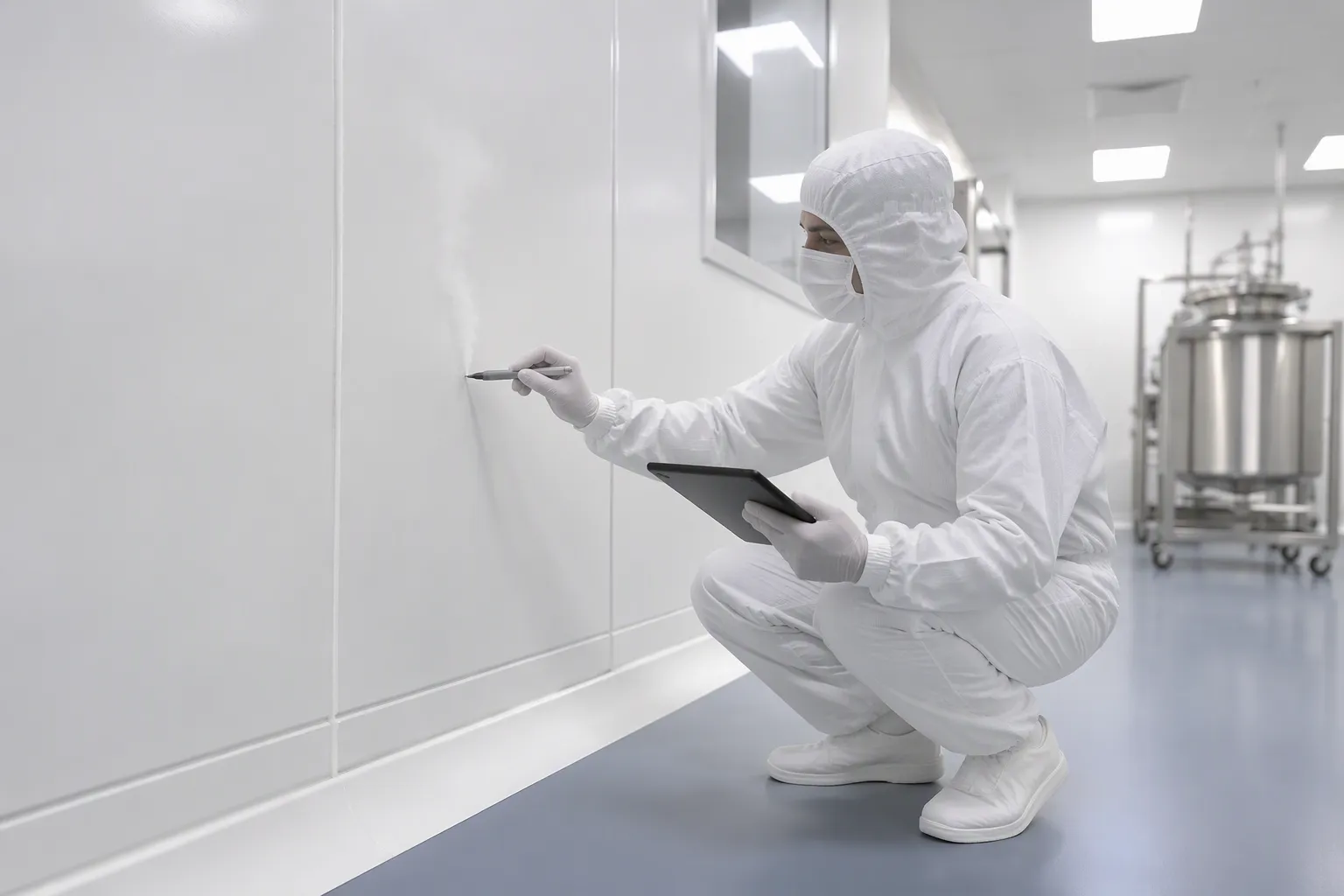
Panels must be non-shedding, non-porous, smooth, moisture-resistant, easy to clean, and resistant to microbial growth. These six properties form the direct answer to most cleanroom wall panel requirements questions. A practical evaluation covers six factors, and each one has a verification method.
|
Factor |
Why It Matters |
How to Verify |
|---|---|---|
|
Resistance to shedding |
Stops particles from contaminating the environment and products |
Surface wipe tests plus particle-count comparison |
|
Cleanability |
Supports validation of cleaning procedures |
Validation coupons and residue measurement after cleaning |
|
Durability against impact or abrasion |
Preserves surface integrity under traffic and use |
Visual inspection and adhesion pull-off testing |
|
Fire safety |
Meets building and insurance code requirements |
Review of test certificates and core material verification |
|
Chemical compatibility |
Avoids surface degradation from cleaning agents |
Accelerated exposure testing of the material |
|
Seal integrity |
Maintains pressure differentials and blocks ingress |
Smoke pencil testing and pressure-drop verification |
Non-Shedding, Non-Porous Surfaces
A solid, non-fragile surface must not generate particles through wear or cleaning. Non-porous faces stop the absorption of microorganisms, chemicals, or moisture that could otherwise become contamination sources. Coated steel, aluminum, and specialized polymers meet this profile. Joints deserve equal attention. A panel with an excellent finish can still fail if joints leak or field-cut penetrations go unsealed.
Why No Panel Material "Is" an ISO Class
ISO 14644-1 classifies the airborne particle concentration of an installed room, not a raw material. A panel alone does not create an ISO class, certify a room, or prove sterile status. The envelope must work as a complete, cleanable, sealed assembly. Panels, framing, joints, coves, ceiling and floor interfaces, doors, windows, penetrations, and seals all interact. Final compliance therefore depends on full facility design, operation, and validation, not a material name.
For an ISO 7 cleanroom, selection follows criteria rather than a blanket material claim. Standard PIR/PUR or rock wool core panels with coated steel skins suit the class. The surface should reach Ra ≤ 1.6 µm, smooth and unbroken per EU GMP Annex 1. A high air-tightness tongue-and-groove joint system is required. Rock wool achieves Euroclass A1/A2, while PIR/PUR rates B-s1,d0 or Class A. The surface must withstand IPA, bleach, hydrogen peroxide, and peracetic acid without degradation. Non-shedding performance is verified through IEST-RP-CC018 wipe tests and particle count monitoring. Engineered tongue-and-groove joints with gaskets, or cam-lock systems, prevent leakage.
Cleanroom Wall Panel Materials
Fire Rating, Chemical Resistance, and Cost
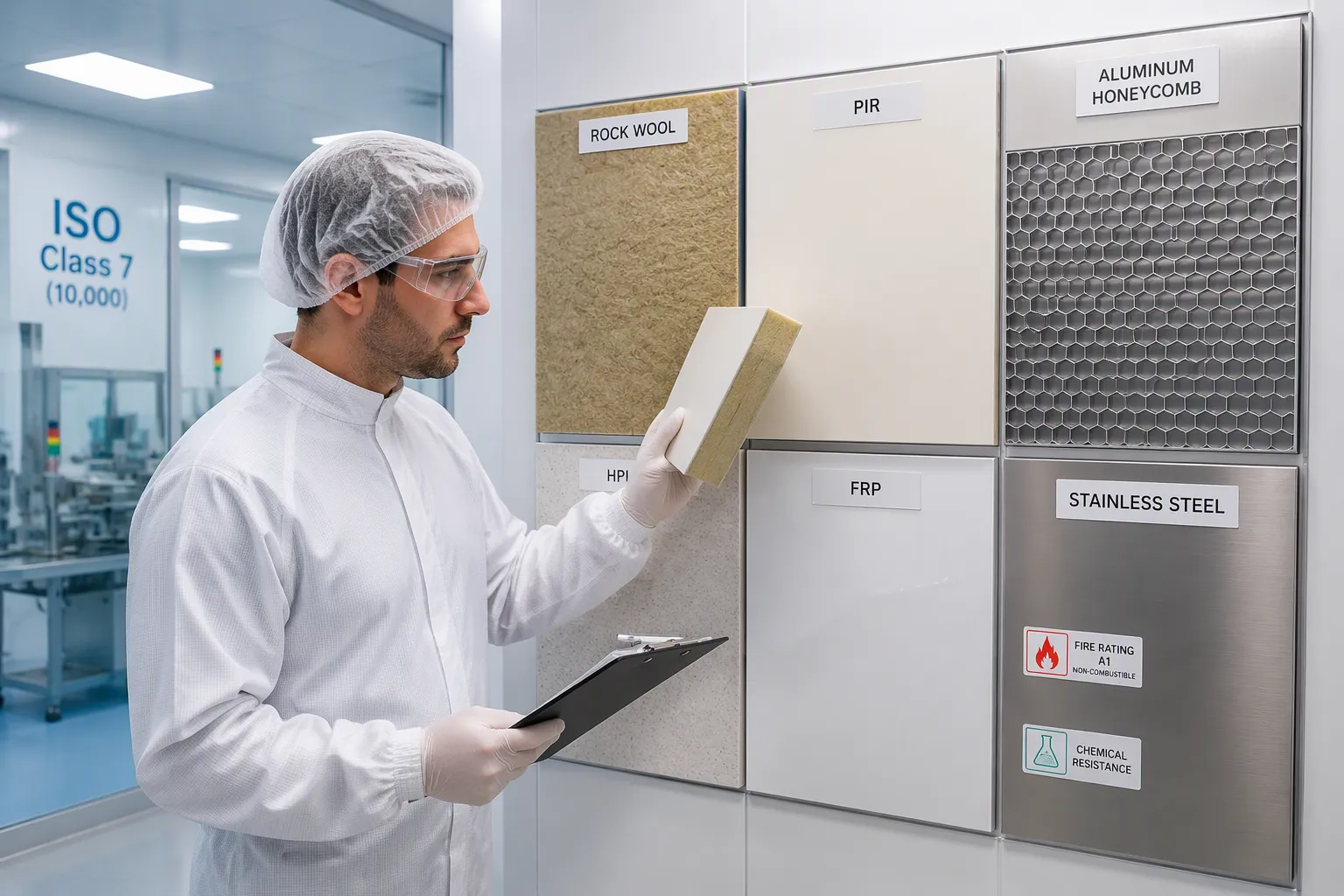
Fire reaction classes run from A1 (non-combustible) through A2, B1, B2, to B3 (easily flammable). Rock wool reaches Class A1 and will not melt, ignite, or produce flaming droplets under direct fire exposure. PIR carries Class B1 with flame retardants and offers better dimensional stability at high temperatures than PU. Aluminum honeycomb typically achieves Class B1 or Class 0. Where a jurisdiction demands A1/A2 materials, rock wool, MGO, or aluminum honeycomb fit; where B1 is acceptable, PIR becomes a cost-saving alternative.
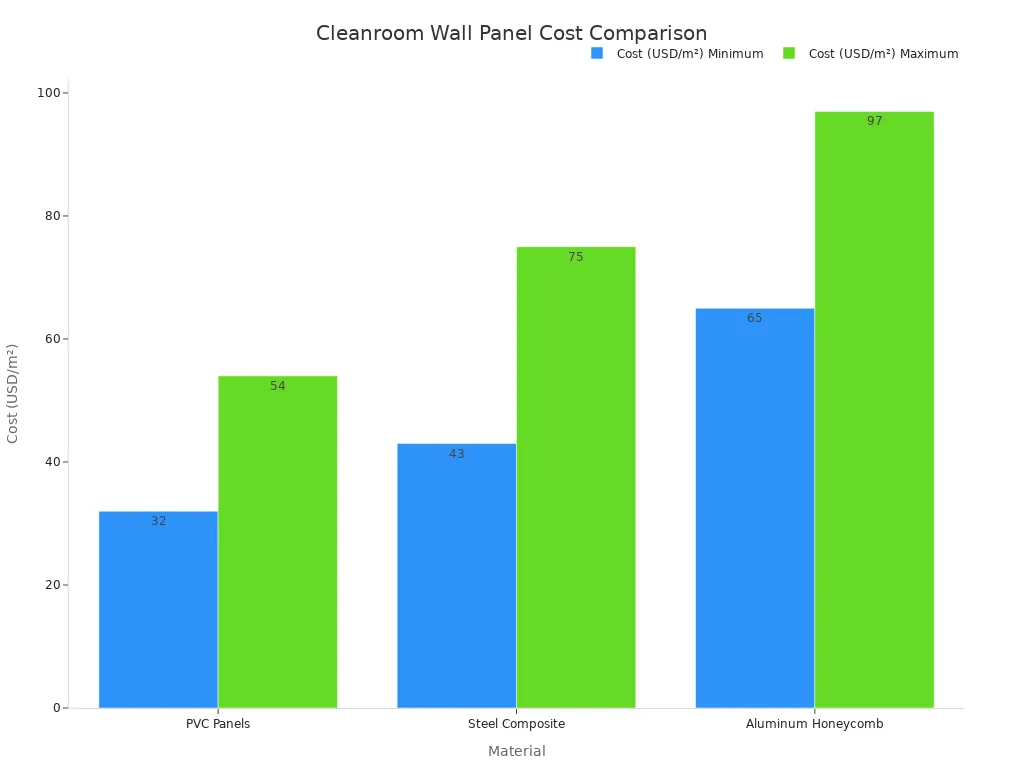
Chemical resistance separates the options further. HPL withstands corrosion from acid fumes and vapors and tolerates temperatures near 250 °C. FRP resists the aggressive acid- and base-based cleaning solutions common in pharmaceutical cleanrooms. Stainless steel resists corrosion and cleans easily, and its skin does not easily shed. Coated steel also carries chemical-resistant ratings. Cost varies widely: PVC panels run $3–5 per square foot, steel composite $4–7, and aluminum honeycomb $6–9. Insulated metal panel walls cost $24–42 per square foot supplied.
Where Each Material Fits Best
PIR/PU panels suit ISO 5/6 rooms through strong insulation and moisture resistance. Stainless steel serves pharmaceutical and corrosive environments, including ISO 5 areas. Rock wool fits fire-rated projects and adds soundproofing, though it is heavier. Aluminum honeycomb appears in semiconductor, biopharma, and aerospace cleanrooms. FRP modular walls are standard in filling rooms, typically ISO 5, because they handle aggressive cleaning chemicals. HPL suits facilities facing acid fumes. Epoxy-coated panels offer a smooth, homogeneous face that minimizes particle generation. PVC and steel composite cover ISO 7–8 spaces economically.
Heat-welded panel systems deserve attention for higher-cleanliness applications. Welded seams create a seamless, moisture-impermeable surface with no open joint for soil to collect. These systems strengthen cleanroom wall panel requirements around seal integrity and cleanability. Material choice remains one input among several; the assembled envelope determines final performance.
Cleanroom Wall Panels vs. FRP
FRP Performance in Controlled Environments
FRP earns its place through a balanced performance profile. Fiberglass-reinforced plastic offers smooth, non-porous surfaces that clean easily and resist moisture, which suits washdown and humid zones. The material handles aggressive cleaning chemistry well. Test data rates FRP resistance as excellent against 70% IPA, 0.5% sodium hypochlorite, and 5% quaternary ammonium, and good against 3% hydrogen peroxide and 10% HCl. Acid and alkali resistance overall is strong, though actual performance depends on the quality and formulation of the surface coating, and some formulations degrade under prolonged UV exposure.
Fire performance is configurable rather than fixed. Buyers can specify the rating their project needs.
Class A, fire retardant FRP skin is available for this cleanroom wall panel.
Suppliers offer Class A or Class C ratings tested under the NFPA Life Safety Code, with FM Approved products available. FRP also carries a cost advantage over insulated metal systems, and crews can apply it to existing surfaces or mount it in aluminum storefront-style frames.
Matching Panel Type to Application
FRP fits best where hygiene and chemical resistance matter more than thermal insulation. Typical applications include cosmetic manufacturing, food production, gowning rooms, corridors, pharmacies, and laboratory retrofits inside controlled buildings. Industry guidance describes FRP as a popular interior wall facing for modular hardwall pharmaceutical cleanrooms.
Other panel types may be preferred when the facility prioritizes insulation or structural performance. Two-inch modular sandwich panels with stainless steel or aluminum skins serve semiconductor and biotech cleanrooms, life sciences manufacturing, and compounding pharmacies. Thicker insulated panels suit cold zones and exterior envelopes. Selection therefore follows facility priorities: cleanliness and hygiene point toward FRP, while thermal performance and structural demands point toward sandwich systems.
GMP Considerations for Wall Systems
Cleanability, Joints, and Interfaces
GMP frames wall systems as facility and quality-system requirements, not panel certifications. A panel certificate alone does not satisfy an inspector. The installed envelope must present cleanable surfaces, minimized joints and corners, sealed penetration details, and coordinated interfaces with doors, windows, ceilings, and equipment.
Joint design carries particular weight at interfaces. Door frame to wall panel connections must use seamless welding or cleanroom-grade specialized caulking, so dirt traps are eliminated. Teams should maintain wall joint caulking records as an audit focus item.
|
GMP Aspect |
Requirement / Expectation |
|---|---|
|
Wall joint design (door frame to wall panel interface) |
Joints must be constructed using seamless welding or cleanroom-grade specialized caulking so that dirt traps are eliminated. |
|
Verification / audit evidence |
Wall joint caulking records must be maintained and available as an audit focus item. |
These details turn cleanroom wall panel requirements into verifiable facility conditions. A smooth panel face means little if a door frame junction leaves an open gap.
Documentation for Qualification
Acceptance rests on a documented package. Product data sheets describe composition, finish, and performance ratings. Test reports cover fire reaction, chemical resistance, and surface properties. Installation instructions define sealing methods and joint tolerances. Project validation files tie these documents to the installed assembly and its qualification results.
Buyers should verify the applicable GMP regulation and version for the target market. They should cite official documents rather than treat "GMP compliant" as a marketing term. A claim without a named regulation, version, and test reference carries no audit value.
Product Specifications and Selection
Panel Type, Core, and Surface Finish
PingerPanel supplies modular cleanroom wall panels built on an aluminum honeycomb core with aluminum skins. Standard skin thickness is 0.032", with 0.025", 0.040", and 0.063" available. Surface finishes include acrylic or epoxy paint in Designer White, Polar White, Shell White, and conductive or static-dissipative options. Epoxy surfaces measure 10⁷–10⁹ ohms/sq resistivity, and acrylic enamel reaches 60° gloss ≥ 80%. Pencil hardness runs Eagle Turquoise F–H, adhesion passes a 1/16" dry crosshatch with no tape-off, and the finish passes 3% detergent resistance for 100 hours at 100°F.
|
Specification |
PingerPanel Value |
|---|---|
|
Panel type |
Modular cleanroom wall panel |
|
Core |
Aluminum honeycomb (hexagonal, expanded) |
|
Facing |
Aluminum, standard 0.032" |
|
Surface finish |
Acrylic or epoxy paint |
|
Joint system |
Tongue-and-groove, air-tight |
|
Cleaning compatibility |
Confirmed against project cleaning agents |
Dimensions, Joints, and Technical Documents
Panels come in 1150 mm widths and 50 mm to 100 mm thicknesses. The tongue-and-groove edge profile reduces air leakage and supports pressure control. Coved aluminum bases eliminate dead corners in GMP areas, and service penetrations use the same gasket and trim logic as panel installation.
Publish only specifications that match actual product data. A brand without a dedicated cleanroom panel line or sufficient documentation should not present itself as a cleanroom supplier.
Buyers should confirm cleanroom wall panel requirements against a checklist: match the panel to the ISO class, verify air tightness, review joint design, check surface properties, and collect the required documents. These include span charts, fire test reports with full assembly scope, salt spray results, water absorption data, and cleanability test records.
Installation and Maintenance
Sealing, Joints, and Interfaces
Installation quality decides whether the envelope performs as designed. Crews should align tongue-and-groove edges before fixing, then seat gaskets fully along the panel length. Sealant beads belong at every field joint, base cove, and penetration. A continuous bead prevents air leakage and blocks moisture ingress at the seam.
Interface coordination deserves the same care. Door frames, window units, ceiling grids, and equipment penetrations each create a junction where panels meet other systems. Teams should sequence these connections so trim and gaskets close every gap. A smooth panel face means little if a door frame junction leaves an open channel for soil and air.
Cleaning and Disinfection Compatibility
Panel compatibility depends on the agent, not the panel name alone. The table below summarizes verified pairings.
|
Material |
Compatible Agents |
Agents to Avoid |
|---|---|---|
|
Stainless steel |
VHP, bleach at verified dilutions, quats |
Prolonged harsh contact without rinsing |
|
uPVC / HPL |
Phenolics, 70% IPA |
Main risk is moisture at failed seams |
|
Acrylic |
Mild surfactants, low-concentration IPA |
Acetone, high-concentration bleach |
|
Polycarbonate |
Mild surfactants, controlled low-concentration IPA |
Acetone, high-concentration bleach |
Metallic panels tolerate the most aggressive sporicides, including VHP. A 70% IPA wipe-down afterward neutralizes residues and protects the oxide layer from oxidation and streaking. HPL and uPVC withstand frequent heavy washdowns and standard pharmaceutical disinfectants. Their main vulnerability is edge-seal integrity, not chemical attack. Acrylic and polycarbonate have a narrow profile; acetone and high-concentration bleach cause immediate crazing.
A sound disinfection schedule follows three steps:
-
Use a quaternary ammonium compound for routine daily disinfection of compatible surfaces.
-
Rotate a sporicide into the schedule, such as weekly, to prevent microbial resistance and destroy adaptive biofilms.
-
Follow every sporicide treatment with a 70% IPA wipe-down to remove sticky residue and protect materials like stainless steel from oxidation.
Classification defines the environment, the environment defines panel requirements, and materials compete on measurable performance. GMP compliance comes from facility design, documentation, and validation, not a panel name.
Wall systems should be selected based on durability, cleanability, and the specific environment.
Verify product data and the applicable regulations for the target market.
FAQ
Can a wall panel itself be ISO certified?
No. ISO 14644-1:2015 classifies the installed room's airborne particle concentration. Certification applies to the assembled envelope after validation, not to a panel product on its own.
Which panel suits an ISO 7 cleanroom?
Selection follows criteria, not a material name. Coated steel panels with PIR or rock wool cores work when the surface reaches Ra ≤ 1.6 µm and joints seal tightly.
What documents should buyers request?
Ask for product data sheets, fire test reports covering the full assembly, chemical resistance results, installation instructions, and cleanability records. These support the project validation file and later audits.