Water channels play an important role in agricultural irrigation and regional water distribution systems. Over time, unlined earthen channels can experience water seepage, surface erosion, vegetation growth, and damage caused by continuous water flow. Traditional concrete lining provides a protective surface, but construction may involve formwork, concrete placement, curing, and considerable on-site labor.
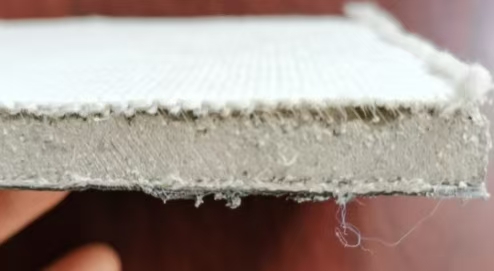
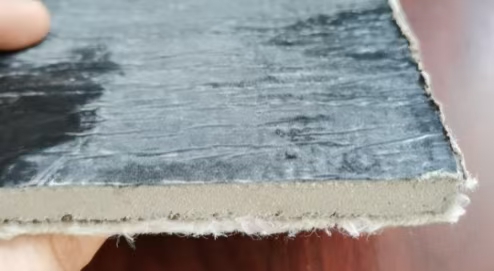
Concrete Canvas, also known as Geosynthetic Cementitious Composite Mat (GCCM), is a factory-manufactured cementitious composite supplied in flexible rolls. It can be installed along a channel profile and hardened through hydration with water. This makes a practical lining option for selected irrigation canals, drainage channels, and erosion protection projects.
NuoKun manufactures concrete canvas in a range of 6–25kg/m². For water channel lining application, 15kg/m² concrete canvas is wort considering.
Technical Parameters
| Item | Specification |
| Unconfined Compressive Strength | >30MPa (after 28 days) |
| Tensile Strength (MD) | 33.5KN/m |
| Water Permeability (cured) | 1×10⁻⁹ m/s |
| Tensile Strength (TD) | 23KN/m |
| Compressive Strength | >98.1MPa |
Main Functions
1. Forms a Continuous Lining to Reduce Seepage
Unlined earthen channels may lose water through soil pores and permeable ground conditions. Once installed and hydrated, concrete canvas forms a continuous cementitious lining along the channel bed and side slopes. For agricultural irrigation systems, this lining can reduce water infiltration into the surrounding soil and improve water conveyance efficiency. Overlaps, longitudinal and transverse joints, channel ends, and changes in direction must be designed and installed properly to reduce potential leakage paths.
2. Protects Channel Surfaces Against Water Erosion
Continuous water flow can gradually erode earthen channel beds and side slopes. In severe cases, this may result in surface deterioration, local scouring, or slope damage. After hydration, concrete canvas forms a fiber-reinforced cementitious layer that protects the underlying soil from water flow.
3. Controls Vegetation and Reduces Maintenance
Unlined channels can experience weed growth, sediment accumulation, and localized damage to the channel profile. These conditions increase routine cleaning and maintenance requirements. Continuous cementitious lining can reduce exposed soil areas and suppress vegetation growth along the channel bed and slopes. This reduces some maintenance requirements and maintains more consistent channel conditions.
4. Provides Flexible Installation Along Channel Profiles
Concrete Canvas is supplied in roll form and can be unrolled, cut, and positioned to meet the dimensions of the channel bed and side slopes. For relatively regular channels, installation teams plan roll widths and laying directions to meet the designed cross-section. Additional planning is required at curves, changes in slope, and irregular structural sections.
A Real Case
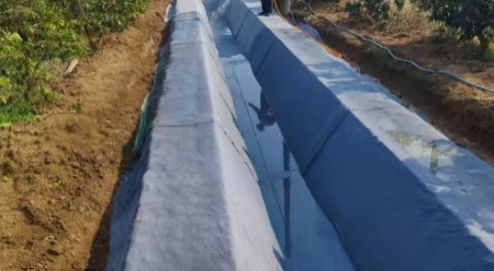
Water channels in Abu Dhabi are exposed to high temperatures, intense sunlight, and continuous water flow. Traditional earthen channels may experience water seepage, side-slope erosion, vegetation growth, and increasing maintenance requirements. For agricultural irrigation and water conveyance projects, improving channel lining durability, reducing water loss, and managing construction time are important engineering considerations.
15 kg/m² concrete canvas (GCCM) can be considered as a channel lining solution for suitable site conditions. Supplied in rolls, the material can be cut, positioned, and secured to meet the dimensions of the channel bed and side slopes. After installation, it is hydrated with water and hardens into a cementitious protective layer. Compared with conventional cast-in-place concrete, concrete canvas offers a more flexible installation process for seepage control and erosion protection.
Two months after installation, concrete canvas provides surface protection for channel beds and side slopes. It reduces water erosion, soil deterioration, and seepage risks while limiting vegetation growth and routine maintenance requirements.
FAQ
Q1: What's in it for you when you choose us?
Certification: GB/T19001-2016/ISO9001:2015.
Final inspection is performed before shipment.
Competitive Prices: Factory Prices, No Middlemen.
Q2: What Concrete Canvas weights does NUOKUN manufacture?
NuoKun manufactures concrete canvas ranging from 6 to 25 kg/m². Customers can select a suitable weight to meet the application, channel structure, and project specifications. For water channel lining projects, 15 kg/m² can be evaluated as an option.
Q3: Can Concrete Canvas completely eliminate water seepage?
Concrete canvas forms a low-permeability cementitious lining and reduces seepage. However, complete seepage prevention cannot be guaranteed by material weight alone. Many factors influence the seepage-control result, such as joint treatment, anchoring, subgrade conditions, and installation quality. Projects with strict seepage-control requirements should define performance targets and joint details during the design stage.